
Des Moines Previous Resident Sources
A sound address history uses sources in time order. Current parcel tools establish the place, the Polk County Recorder tracks recorded instruments, and older shelves extend the trail before the online cutoff. Des Moines directories can name an occupant without proving ownership. A deed can name a party without proving that person lived there. Sanborn maps describe the building, not the household. The table sets out the useful eras and the question each source can answer.
| Source | Time span | Custodian | Best evidence |
|---|---|---|---|
| Recorder online index | 1992 to present | Polk County Recorder | Instrument parties, kind, dates, file and book/page |
| County land indexes | Deeds from 1848; lot index from 1851 | Polk County Archives | Earlier deed, mortgage, and lot references |
| City directories | Digitized 1866 to 1922; other formats later | Des Moines Public Library | Dated names, street entries, firms, and household clues |
| Census collections | Iowa series 1850 to 1925; federal through 1950 | State Historical Society of Iowa | Household membership at an enumeration date |
| Sanborn maps | 1884, 1891, 1901, 1906, and 1920 to 1957 runs | DMPL and Library of Congress | Building footprint, material, use, and number clues |
For recent work, save the current parcel ID and legal description before searching names. For an address before 1992, call Imaging/Microfilm or Polk County Archives rather than treating a blank web result as final. For an older occupant, move from the address guide to a census, newspaper, probate, or cemetery source. The strongest finding is a dated chain in which independent records agree.
Key Des Moines Resident Addresses
Normalize the present street line through Show Me My House. Its single address field expects a number, prefix, street name, and suffix. The result can connect the location to a parcel, neighborhood, ward, precinct, zoning area, Census block, and city services. The City warns that the output is approximate and incomplete. It is a routing tool, not a survey or proof that a named person lives there.
Next, open the Polk GIS Explore app and record the parcel ID and legal lot. Keep a search log with the date, spelling, street prefix, suffix, ZIP, parcel number, and map version. Those details matter when an older source uses a different number or an instrument names the subdivision instead of the street.
Note: A parcel owner, deed party, directory occupant, and postal contact are distinct roles and should not be merged into one resident claim.
Trace Des Moines Resident Deeds
The Polk County Recorder search route covers real-estate instruments from 1992 forward. Its name form supports party roles, date ranges, index groups, and instrument kinds. Results may show recorded and instrument dates, indexed names, remarks, file number, book/page, amount, and image controls. Read the kind before drawing a conclusion. A mortgage, easement, release, plat correction, contract, or quit-claim deed does not mean the same thing as a warranty deed.
- Use the assessor and GIS to capture the current parcel and legal description.
- Find the newest plausible purchase instrument and verify its kind, parties, dates, and legal remark.
- Search the seller as a grantee to locate that party's earlier acquisition of the same legal lot.
- Repeat only while the legal description and instrument sequence remain consistent.
- At the 1992 cutoff, contact Imaging/Microfilm at 515-286-3175 and give the known book/page, lot, or party details.
- Grantor and grantee
- The grantor transfers a recorded interest; the grantee receives it.
- Chain of title
- The ordered series of recorded transfers tied to the same land.
- Legal description
- The lot, subdivision, or survey wording that identifies land more reliably than a changeable street address.
The Recorder's copy page lists free online copies for the indexed era plus counter, mail, email, and certified routes. A request works best with a file number or book/page and a clear choice between a plain and certified copy. This access channel matters when an image button fails.
Older Des Moines Resident Trails
The online cutoff is only a portal limit. Polk County Archives lists deed and mortgage land indexes from 1848 through May 1952 and lot indexes from 1851 through July 1959. It also holds Des Moines city directories from 1920 through 2002, county records from 1864 through 1934, and other series with their own end dates. Ask archivist Nedim Bashich for a named series, date range, lot, and known reference instead of requesting a broad resident file.
The State Historical Society's Polk County inventory adds deeds, mortgages, plats, probate, naturalization, tax-sale deeds, sheriff deeds, easements, and farm-name records. The Des Moines Research Center is at 600 E. Locust Street. Its listed schedule is Wednesday through Friday, 9:00 to 4:30, and Saturday, 9:00 to 3:00. The 2026 collections move can limit access, so contact staff at least five days before a visit.
The official Polk holdings page shows what can survive beyond a portal cutoff. Review the Polk County record inventory before choosing a film or series.
The inventory helps route a previous-residents search by record type and era, but a catalog entry still requires inspection of the cited volume or film.
Des Moines Previous Resident Maps
DMPL's Sanborn map access and the Library of Congress Des Moines holdings show footprints, construction materials, uses, lots, and sometimes house numbers. Available Des Moines sets include 1884, 1891, 1901, 1906, and later 1920 to 1957 material. These maps cannot name an ordinary household. They establish what stood on the lot and how the block changed.
A useful local sequence starts with a 1901 footprint, checks a 1908 street-index directory, follows the 1920s plat or deed, then compares the current GIS parcel. This story works because each record keeps its own role. It can reveal a rebuilt structure, divided lot, renumbered house, or changed use without claiming that one source proves the whole history.
Des Moines numbering adds another trap. City guidance uses 100 numbers per block and different odd-even rules around the Des Moines River and South Union. Annexations created duplicate street-name and address problems. Preserve directional letters and test the legal description when a past resident seems to vanish.
The City's CouncilDocs archive can help resolve those changes. Search a street, subdivision, or project name within ordinances, resolutions, agendas, and communications. Annexations, street vacations, naming actions, public improvements, and historic-district matters can all explain why a current address fails in an older index. Council files do not identify a household by themselves. Use the dated action to translate the place, then return to directories, deeds, and census schedules under the earlier form.
Keep map scale in mind as well. The city street mapbook is useful for quadrant letters and the broad grid, but it cannot settle a parcel boundary. A Sanborn sheet is rich in building detail, yet its sheet date controls what it can show. Current GIS offers modern geometry, not a certified title opinion. When these sources disagree, the recorded legal description is the steadier bridge across time.
Des Moines DMPL Resident Evidence
Des Moines Public Library's histories and images gather planning maps, city histories, postcards, oral histories, and other place evidence. The collection can explain a street, subdivision, or neighborhood change that a deed row alone cannot. Search an exact street or organization, note the item title and year, and cite the page or image where the address appears.
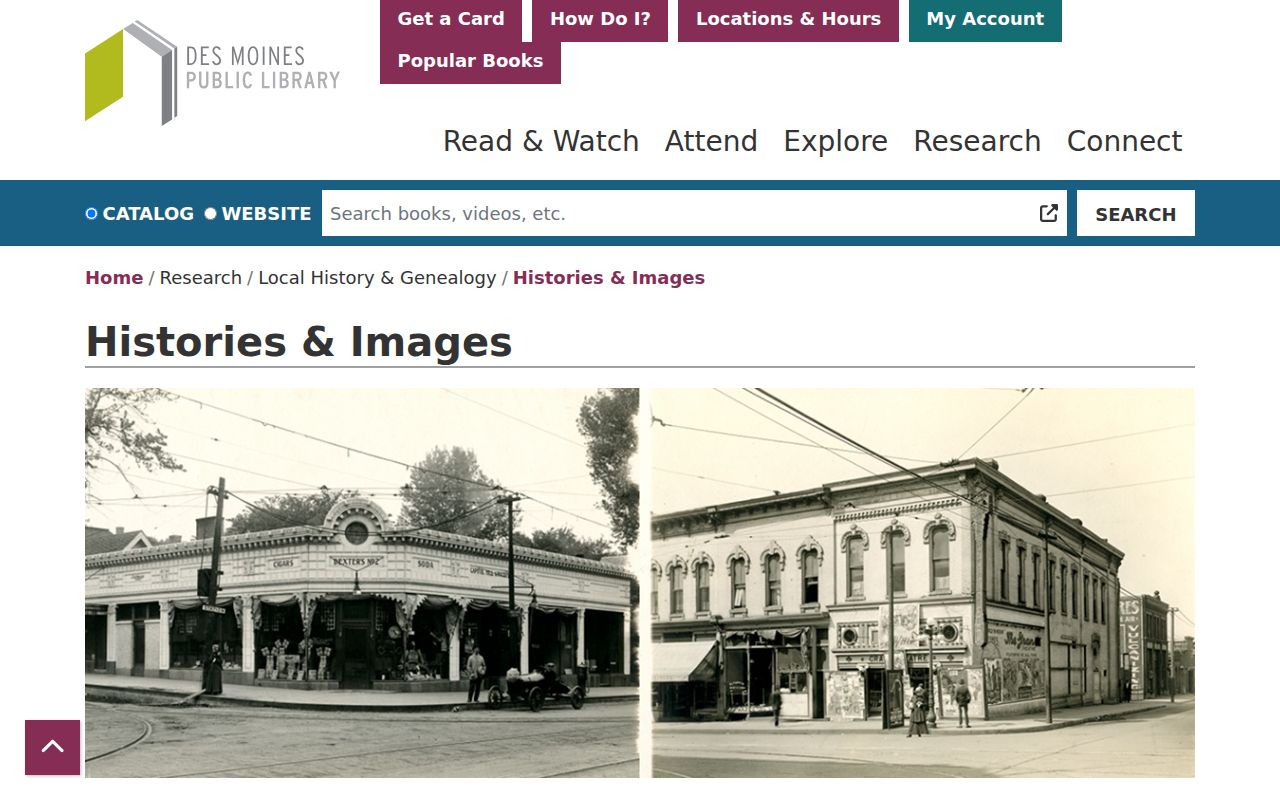
The library collection supplies the visual and local context around past residents while the Recorder and directories carry the dated name-and-place evidence.
For the directory runs themselves, the Des Moines city directory page covers publishers, formats, and reading methods. Here, use the address guide as one link in the backward chain and record the directory year, page, spelling, address, and entry type.
Des Moines Resident Address Changes
Old Des Moines addresses can disappear even when the building or lot did not. City numbering rules use quadrant references tied to the Des Moines River and South Union, while annexations created duplicate street-name and address problems. A 2009 City Council communication records some of those conflicts. Compare the old directory form with the street mapbook, CouncilDocs, parcel legal description, and USPS result before deciding that an address has no trail.
The parcel and legal description provide the steadier bridge when a street was renamed, renumbered, or moved into a different quadrant. Record both address forms and the date of each source. That keeps two different Des Moines places from being combined into one line of previous residents.
Confirm Des Moines Resident Households
DMPL digitizes directories from 1866 through 1922, holds print volumes from 1910 forward, microfilm from 1866 through 1935, and print phone books from 1957 forward. An address guide may name an occupant or firm in a given year. It does not prove title, and missing years can hide a short stay. Pair neighboring directory years with an available Iowa or federal census schedule.
- Find the address in a street or avenue guide and save the directory year and page.
- Search the named household under surname variants and decode the volume's abbreviations.
- Check a census year near that directory date for household members and location context.
- Compare the address and names with the deed chain, allowing for moves and number changes.
- Add a newspaper, obituary, probate, or cemetery citation when it confirms a dated connection.
The DMPL newspaper and magazine index includes Des Moines Register indexing from 1986 to 2020 and obituary indexing from 1960 to 2020. It is an index, not full text. Library staff also offer paid obituary research from microfilm with the stated processing and quality limits. Probate files at the State Historical Society and the City cemetery search can corroborate a death or family tie, but certified vital records follow separate eligibility rules.
Lawful use. Research previous residents for house history, genealogy, or estate work. Never use a historical trail to track, threaten, or harass a living person.
Finish with a source log, not a forced answer. Record each query date, exact address form, parcel or book/page, directory year, map sheet, and repository. If records disagree, preserve the conflict. A reproducible Des Moines address history is more useful than a confident name with no date or citation.