
Des Moines Directory Shelves
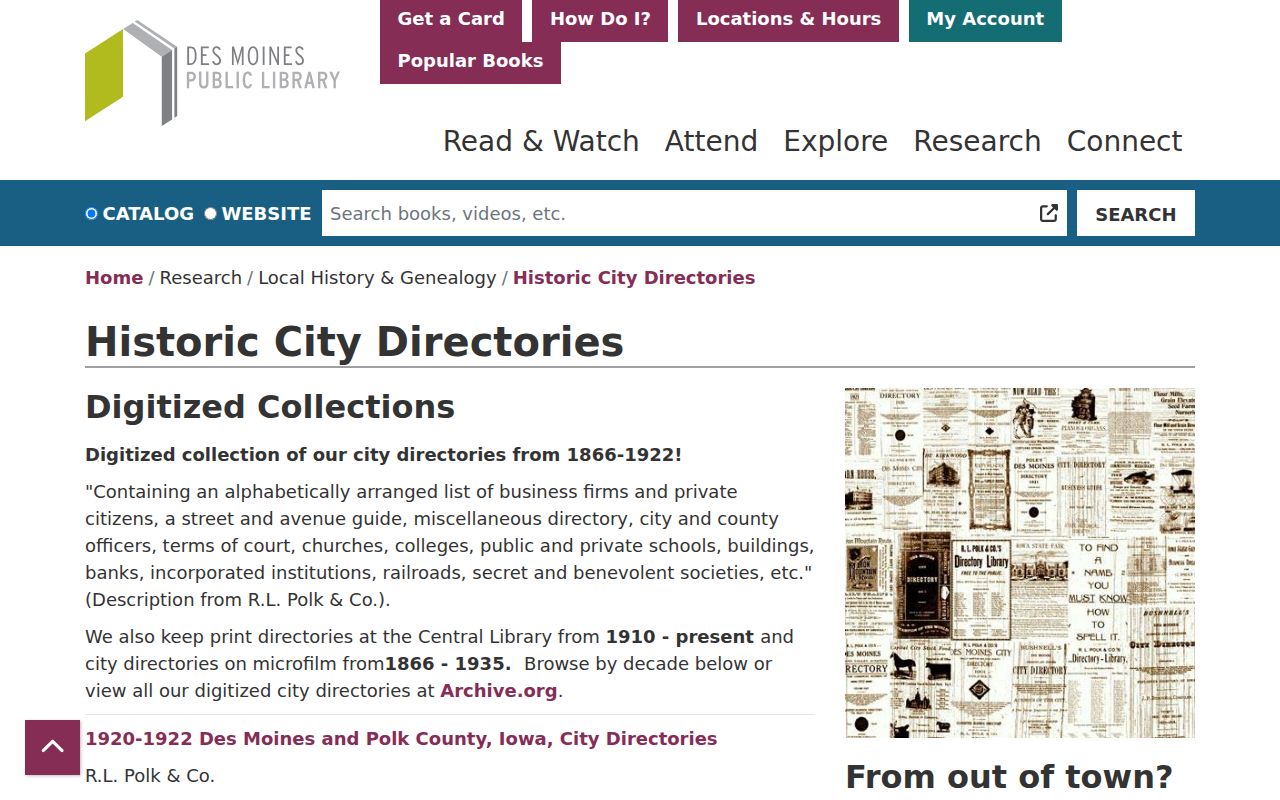
The Des Moines Public Library is the main directory repository. Its historic collection documents publisher changes, gaps, and several ways to read the books. Digitized volumes cover the earliest run through the early twentieth century. Central Library adds print and microfilm for later work, while phone books extend the address-oriented shelf into the modern era.
| Collection | Years | Where Held | Access |
|---|---|---|---|
| Mills & Co. directories | 1866, 1869 | Des Moines Public Library | Digitized collection and microfilm |
| J.P. Bushnell directories | Selected years, 1871-1889 | Des Moines Public Library | Digitized collection and microfilm |
| R.L. Polk directories | Selected years, 1892-1922 | Des Moines Public Library | Digitized collection; later print and microfilm |
| Central Library print run | 1910-present | Central Library, 1000 Grand Avenue | In-person print holdings |
| Library microfilm run | 1866-1935 | Des Moines Public Library | In-person microfilm |
| Print phone books | 1957-present | Des Moines Public Library | In-person print holdings |
Coverage is not annual throughout. The 1870s, 1880s, and 1890s each have skipped years, and 1918 is absent from the library's listed R.L. Polk sequence. Record the exact edition used. The library's historic collection page links the decade collections and explains the shelf formats.
Des Moines Directories Through Time
Publisher and format changes help date an entry. They also explain why the same surname may be indexed differently from one decade to the next.
| Year or period | Collection milestone |
|---|---|
| 1866 | Mills & Co. issued the earliest directory in the library's listed run, the same year the city timeline marks railroad and library milestones. |
| 1871-1889 | J.P. Bushnell appears in selected editions across the 1870s and 1880s. |
| 1892-1922 | R.L. Polk dominates the surviving digitized sequence, with gaps in the listed years. |
| 1910-present | Central Library lists a continuing print collection. |
| 1957-present | Print telephone books add a later address and phone layer. |
Des Moines grew from roughly 12,000 people in 1870 to 126,000 in 1920 according to State Historical Society educational material. That growth helps explain thicker volumes, new streets, and expanding civic listings. It does not imply that every resident appeared in every edition.
Read Des Moines Directory Entries
An R.L. Polk volume combines an alphabetical directory of private citizens and businesses with a street and avenue guide, plus civic sections for offices, courts, churches, colleges, schools, banks, institutions, railroads, and societies. A name in one of those sections may describe a business or office, not a home. Identify the section before extracting the entry.
| Name | Alphabetized personal or business name; test spelling variants and initials. |
|---|---|
| Occupation or business | A work or trade label that helps distinguish people with the same name. |
| Address | House number and street as printed in that edition, checked against the street guide. |
| Household notation | Spouse, widow, boarding, residence, or other coded relationship when the edition supplies it. |
| Edition citation | Directory title, year, publisher, page or scan number, and repository. |
No actual person-specific page was transcribed in the research file, so marks must be read from the abbreviation key in the chosen volume. Do not assign a universal meaning to a letter without checking that edition.
- Criss-cross directory
- A later directory arranged by street and house number, letting a researcher read a block in address order.
- Householder index
- An address-oriented list of the named person associated with a household in that edition.
- Abbreviation key
- The volume's own legend for shortened occupations, relationships, residence marks, and other codes. Save it with the entry.
Extend Des Moines Directory Clues
A directory entry becomes more useful when a newspaper supplies a date, event, or relationship. The Des Moines Public Library newspaper and magazine index accepts keyword, title, subject, author, surname, source, and year approaches. It is an index, not full text. Des Moines Register items are indexed for 1986 through 2020, with obituary indexing for 1960 through 2020. The library lists other local publication ranges as well.
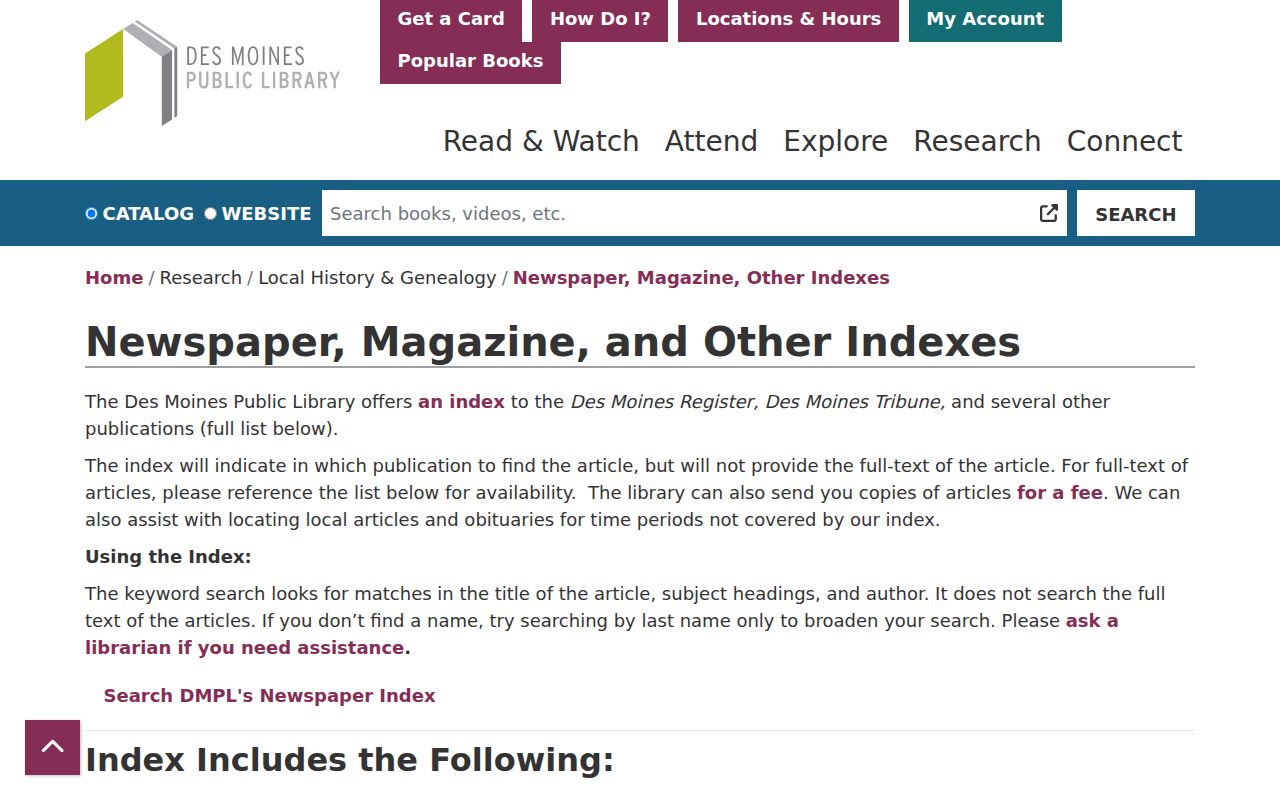
The separate Des Moines Register archive lists historic full-page access from 1871 through 2008 and a later full-text route with access limits. Library card and embargo rules vary by period, so verify the current login and range.
DMPL staff also offer premium obituary research from Register and Tribune microfilm. The listed route asks for the deceased person's name, death date, source or date if known, and return method. Current terms list $10 for one notice or $20 per hour for multiple notices, with a maximum of four and stated processing of ten business days. Confirm fees before ordering.
Map Des Moines Directory Addresses
Street names and house numbers can change. The library's history collection links an 1899 preliminary major-street plan, a 1925 proposed-streets map, and a Street Naming Ordinance index. Sanborn fire-insurance maps add building footprints, materials, use, lot context, and some house numbers. They do not normally name residents.
Pair the map with the matching printed volume. A 1901 Sanborn sheet can show that a structure existed, while a 1908 directory street index can supply a dated household clue. Later plat and deed evidence can tie the lot to the current parcel. This four-part story is stronger than assuming that today's street line existed in the same form.
For modern parcel and owner research, move to the Des Moines street directory. Its address-first workflow keeps the historical collection from being mistaken for a current resident roll.
Note: A Sanborn footprint, directory entry, and deed each answer a different question, so cite the year and repository for all three.
Des Moines Records Beyond Directories
The State Historical Society of Iowa holds Polk County microfilm and records that can confirm a historical book lead. The Polk County inventory includes marriages from 1847 through 1926, probate case files from 1846 through 1914, a naturalization index, selected early births and deaths, and land-record series reaching into the nineteenth century. One deeds date string on the source page appears anomalous, so check the catalog rather than silently correcting it.
The society's census guidance covers federal census access through 1950 and Iowa state census series from 1850 through 1925. Census records can test household relationships near a directory year.
The Des Moines Research Center lists hours Wednesday through Friday, 9:00 a.m. to 4:30 p.m., and Saturday, 9:00 a.m. to 3:00 p.m. A 2026 storage and renovation move limited archive access, with return scheduled for November 2026. Contact the center at least five days before a research visit.
Ask Des Moines History Keepers
Central Library, at 1000 Grand Avenue, holds directories, newspapers, maps, images, and local research services. Call 515-283-4152 to confirm current hours and access to print or microfilm. Polk County Archives can route older county indexes and microfilm by exact series and date range. Archivist contact in the research is Nedim Bashich, 515-286-2188.
The Polk County Historical Society and Museum has a growing digital collection and staff-assisted research. Its rules do not let outside researchers handle archival materials. Listed research fees differ for members and nonmembers, so ask for current terms and provide the name, date, address, and source already checked.
Des Moines Public Library's Histories and Images collection adds city histories, plans, postcards, oral histories, and biographies. These works can explain why a name or street mattered locally, but each detail still needs an item title and page citation.
Trace Des Moines Family History
Begin with a known name and approximate year. Search spelling variants, initials, and other people in the household. Keep a research log for every Des Moines volume checked, including editions with no result.
- Find the first plausible alphabetical entry. Save the title, year, publisher, page, exact spelling, occupation label, and address.
- Check the street guide or criss-cross section. Confirm that the house number and street appear as expected in that edition.
- Move one edition forward and one back. Note each change in address, initials, spouse notation, occupation, or business connection.
- Pair directory years with the nearest federal or Iowa state census. Use household names and ages to separate people who share a surname.
- Test the last appearance with the newspaper index, obituary service, cemetery search, probate files, or a deed. Cite each source independently.
Disappearance from a directory does not prove death or departure. The person may have been missed, listed under another household, recorded with initials, or moved beyond that publisher's coverage. Search adjacent years and spellings. Then use a dated independent source to explain the gap.
Keep negative searches precise. Write down the years, surname forms, street variants, and repositories checked. A gap between two editions can narrow a move or life event, but only an independent record can explain it. If the online scan is hard to read, compare the microfilm or print copy and ask library staff about page order, missing scans, and the volume's index.
A useful citation lets another person reopen the evidence: edition, publisher, year, page or scan, repository, access date, and the exact field used. That discipline turns a printed-directory clue into sound family history.